Skip to content

AI & Data

Is Your Business Ready for AI? 6 Things to Fix Before Implementation

Most Indian companies don't have an AI problem. They have a plumbing problem. Here's how to check if your data, cloud and team are ready.

HavocLLP TeamEngineering team5 min read

  • AI & Data

AI & Data

HavocLLP / Field note
Fig.

Article

Most Indian companies don't have an AI problem. They have a plumbing problem. The demos work. The pilot impresses the board. Then someone asks the model about last quarter's dispatch delays, and it confidently pulls numbers from a spreadsheet nobody has updated since March. That's usually where the excitement ends and the real work starts.
AI adoption in India is moving fast on paper, but the gap between "we're using AI" and "AI runs part of our business" is wide. Here's how to tell which side of it you're on.

Where AI adoption in India really stands

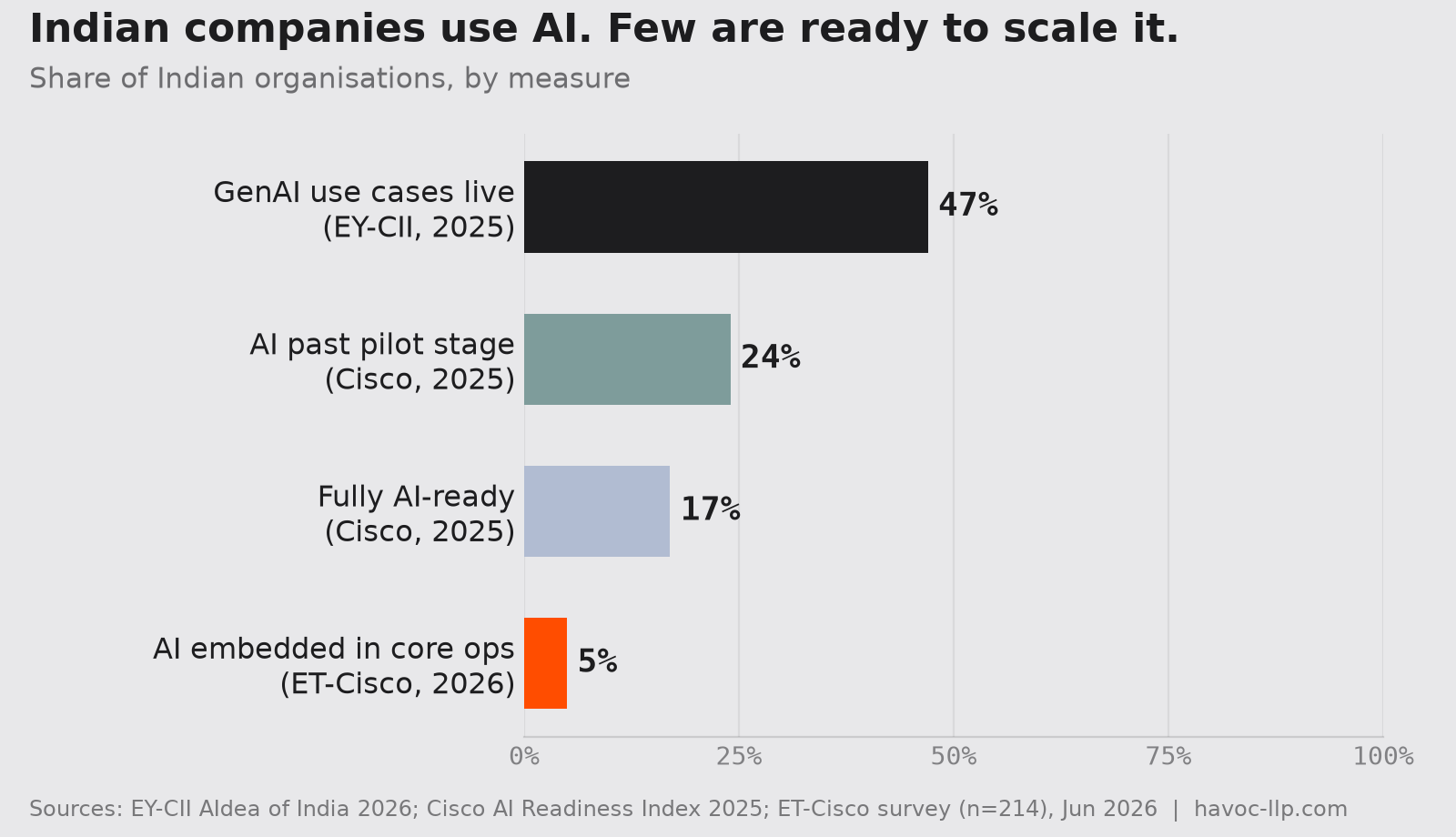
The headline numbers look great. According to the EY-CII report Is India ready for Agentic AI? The AIdea of India: Outlook 2026, 47% of Indian enterprises now have multiple GenAI use cases live in production, with another 23% still in pilots.Look one layer down, though, and the picture changes.
Only 17% of organisations in India are fully prepared to capture the value of AI. — Cisco AI Readiness Index 2025

The same Cisco study found that only 24% have use cases that have moved beyond the pilot stage, and just 40% have a clear way to measure AI's impact.
An ET-Cisco survey of 214 tech leaders, published in June 2026, found the same pattern. 38% of companies are still experimenting through isolated pilots, 32% have deployed AI in select use cases, and only 5% say AI is embedded in their core operations.
Bar chart: 47% of Indian enterprises have GenAI use cases live, 24% are past pilot, 17% are fully AI-ready, and 5% have AI embedded in core operations
The adoption gap: live use cases are common, deep integration is rare.
So, is India ready for AI? The ambition is there. The foundations, for most companies, are not yet. Here are the six things to fix first.

6 things to fix before AI implementation


1. Scattered data


AI is only as good as what you feed it. Nasscom's 2026 study of 200 Indian enterprises found that 58% run AI agents on existing datasets, but connected knowledge bases are rare. In practice: customer records split across Tally, a CRM and three regional Excel files.
A simple test: could a new analyst find your top 10 SKUs by margin last month without asking five people? If not, an AI model can't either.

2. Systems that don't talk to each other


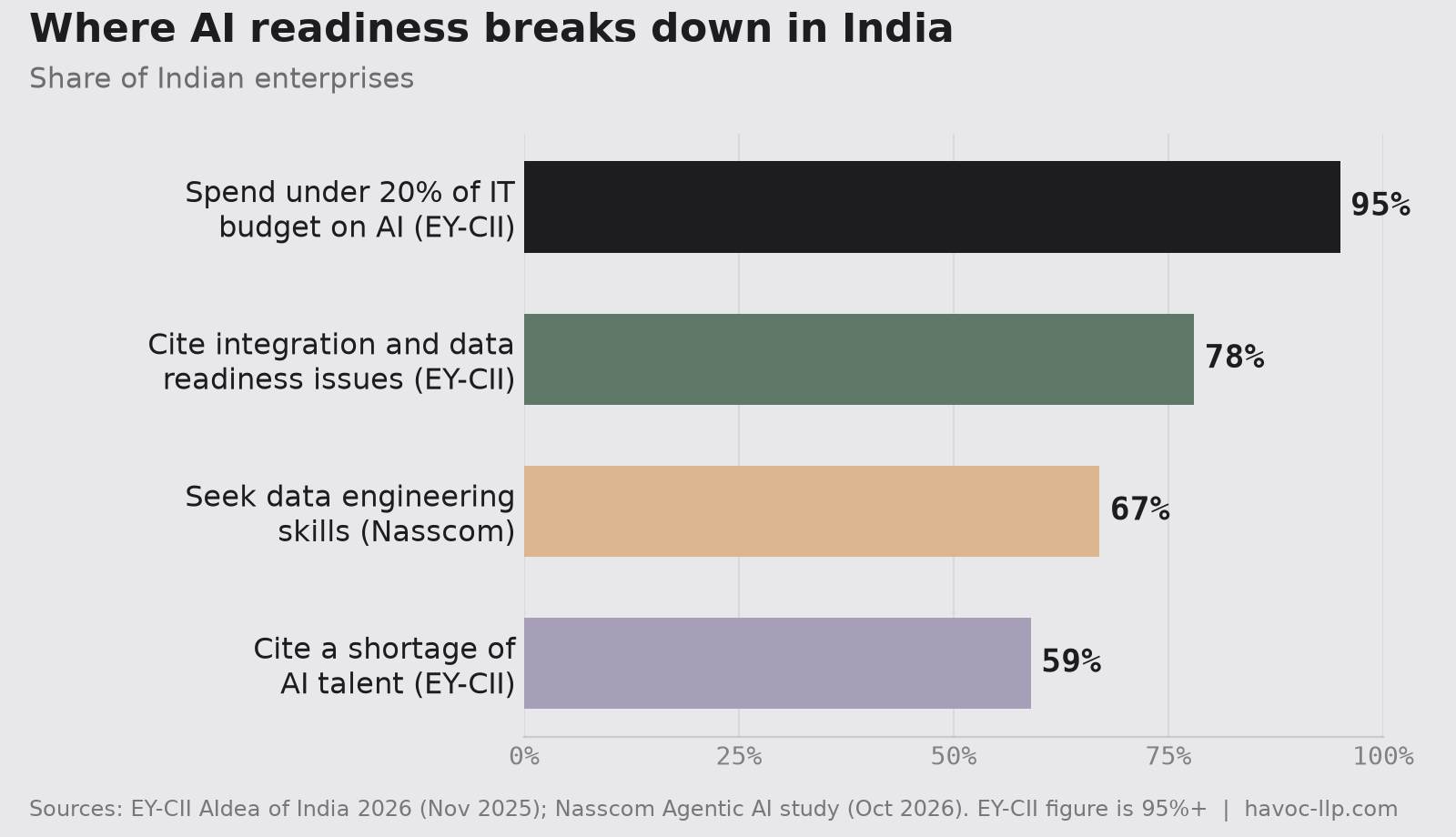
In the EY-CII survey, 78% of leaders named integration and data readiness as a major challenge in scaling GenAI. A model that can't reach your ERP, CRM and support desk will only ever answer half the question.

3. Infrastructure built for yesterday


Many Indian businesses still run critical systems on a server in the back office, or on a cloud setup built for a website. In the ET-Cisco survey, nearly nine in ten respondents called real-time data processing and hybrid cloud connectivity "very" or "extremely" important to their AI plans. Readiness doesn't mean buying GPUs. It means data moves where it's needed, without someone exporting a CSV every Friday.

4. No baseline, no owner


If you don't know how long invoice matching takes today, you'll never prove AI made it faster. And a pilot run only by IT rarely survives contact with operations. Every AI project needs a business leader who owns the number it's meant to move.

5. The skills gap


In the EY-CII survey, 59% cited a shortage of AI talent as a major scaling challenge. Nasscom found 67% of enterprises are looking for data engineering skills specifically, not just data scientists.

Bar chart: 95% of Indian enterprises spend under 20% of IT budget on AI, 78% cite integration and data readiness issues, 67% seek data engineering skills, 59% cite an AI talent shortage
Where readiness breaks down: budget, data, skills.

6. Rules nobody wrote down


What data can an AI tool see? Who checks its output before a customer does? Companies that settle this early move faster later, because they aren't arguing about risk after every pilot. It also helps budgets: EY-CII found over 95% of organisations put less than 20% of IT spend into AI, and clear guardrails make bigger bets easier to approve.

A quick AI readiness check for Indian businesses

Answer these honestly. Each "no" is a gap worth closing before your next AI project.

1. Do we have one trusted source for customer, product and finance data?


2. Can our core systems share data automatically?
3. Can our cloud setup handle more compute without a rebuild?
4. Does a business leader own each AI project's results, against a baseline?
5. Do we have, or can we partner for, data engineering skills?6. Do we have written rules on what AI tools can access and who reviews their output?


Where to start this quarter


You don't need a 50-page AI strategy. You need one use case that matters and the foundations to support it. Pick a process that's repetitive, data-heavy and already measured, like invoice reconciliation or demand forecasting. Clean its data, connect its systems, then bring in AI and measure against your baseline.
That's slower than buying a tool and announcing it on LinkedIn. It's also how the 5% got there.

How Havoc can help


Havoc works with Indian businesses on the layer that decides whether AI works: data pipelines, cloud setup, integration and governance. Our AI consulting services in India start with a readiness assessment of your data, infrastructure and team, so your next project reaches production, not just the demo.
Sources: EY-CII, "Is India ready for Agentic AI? The AIdea of India: Outlook 2026" (Nov 2025); Cisco AI Readiness Index 2025 via The Economic Times (Oct 2025); ET-Cisco Data Infrastructure and AI Readiness Survey via The Economic Times (Jun 2026); Nasscom, "Agentic AI Adoption in Indian Enterprises" (Oct 2026).

HavocLLP TeamEngineering team5 min read

5 min read